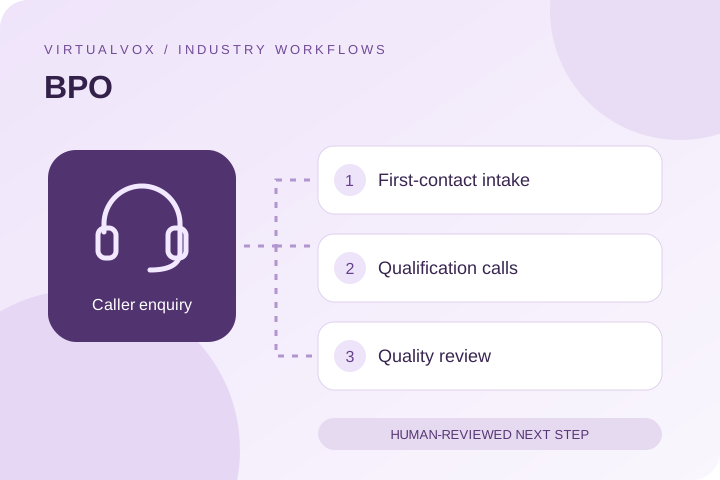
First-contact intake
Capture required fields for a narrowly defined support queue.

Standardise call intake while keeping exceptions visible.
An AI voice agent for BPO teams can support defined intake and qualification workflows with consistent questions and documented handoffs. Evaluate one client process before expanding to other queues.
Different clients have different scripts, escalation rules and data boundaries. A pilot needs to show that calls follow the correct process and that uncertain answers reach a human reviewer.
Capture required fields for a narrowly defined support queue.
Apply client-approved questions to permitted contacts.
Evaluate captured outcomes and missed escalations against a sample reviewed by your team.
This is a proposed script, not a customer recording or a claim that the workflow is already connected. Test interruptions, incomplete answers and requests for a person in your pilot.
CallerI have already called about this issue and need a supervisor.
AssistantI can capture the unresolved issue for the escalation team. Let me explain the next step available in this workflow.
Next step: Assign each outcome to the correct queue and owner. Agree on escalation, callback and any supported transfer behaviour before traffic is added.Contact-centre platform, client CRM and quality review process may be part of your proposed setup. Confirm supported connections, permissions and an approved source of answers with the team. When access fails, collect a request instead of inventing an answer.
Assign each outcome to the correct queue and owner. Agree on escalation, callback and any supported transfer behaviour before traffic is added.
Agree on callback ownership and timing. Confirm live-transfer support for your chosen phone setup separately.
Record a baseline, choose a bounded pilot and have your team review a sample of conversations. Separate requests from confirmed outcomes and record errors alongside successes.
Use the pilot checklist →Capacity must be agreed and tested for your phone setup and traffic pattern. Start with a bounded queue and confirm concurrency, fallback and supervision before increasing volume.
Discuss account separation, access permissions, knowledge boundaries and reporting with the team. Do not assume a shared configuration meets every client’s requirements.
Use comparable call types and review answer accuracy, handoff completion and repeat contact. Call duration alone can hide incomplete work; include human quality review before increasing volume.
Share your contact-centre platform, client crm and quality review process during discovery. Supported access, data fields and failure handling need to be confirmed and tested. The browser demo does not establish that these integrations are available.
Share the languages, accents and mixed-language conversations your callers use. Ask for a demonstration of those exact scenarios before rollout; this website does not publish a verified language coverage list.
Start with expected connected call minutes and a defined call type. Request a deployment-specific quote. Confirm telephony, setup, taxes and integration costs in your quote, then measure cost per useful outcome.
Share call volume, language requirements, common enquiries and the next step your team wants to improve. We can discuss a pilot and the connections it would need.